The Impact of Physical AI from a Software Development Company's Perspective — Why Real-World AI Is the Next Big Opportunity

Physical AI is emerging as the next wave of innovation after Generative AI. This article explores the business opportunities from a software development company's perspective, including Japan’s hardware strengths, the software gap, and advances in simulation technologies.
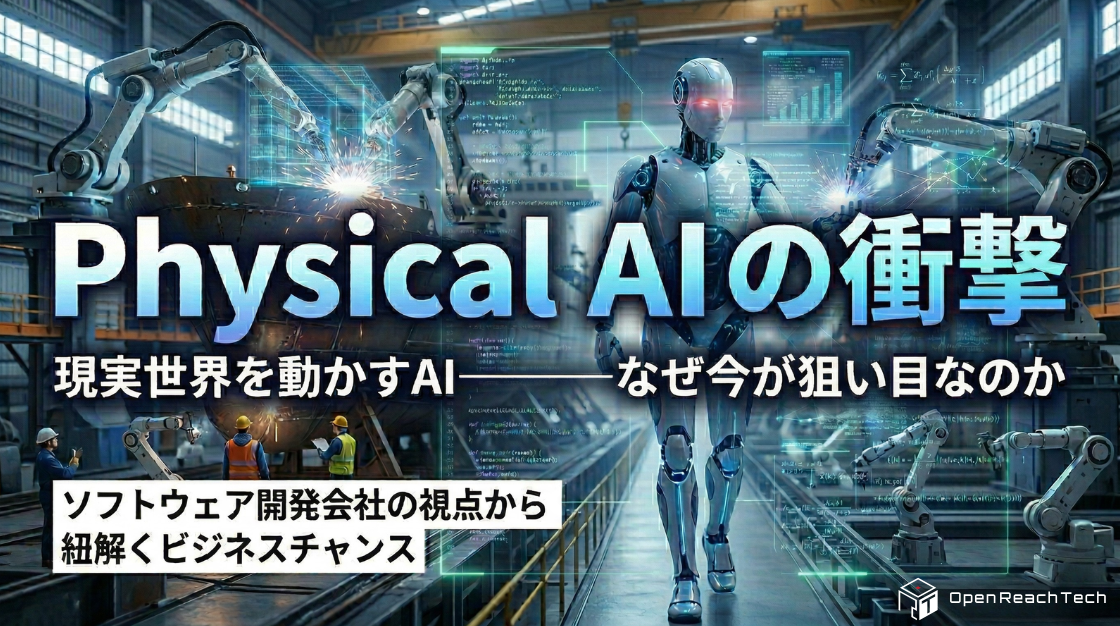
In recent years, Generative AI such as ChatGPT has revolutionized the digital world. However, the next wave of innovation is already moving into the physical world. That wave is Physical AI — the fusion of AI and robotics that enables machines to autonomously perform physical tasks in real-world environments.
NVIDIA CEO Jensen Huang has predicted that:
“Humanoid robots will be walking around within five years.”
Global Big Tech companies and massive private capital investments are positioning this field as the next major battleground in technology. In Japan alone, the humanoid robotics market is projected to reach approximately 12.2 trillion yen by 2050.
At first glance, this may seem like a domain dominated entirely by hardware manufacturers. However, from the perspective of software development companies like Open Reach Tech, this is actually one of the most exciting and opportunity-rich markets today.
In this article, we explore:
- Why Physical AI is becoming such a major opportunity
- What kind of value software companies can provide in this space
1. Japan’s Hardware Strengths and the Software Gap
Japan has historically maintained world-class competitiveness in industrial robotics and robot components.
Japanese companies hold overwhelming global market shares in areas such as:
- precision gear reducers
- motors
- sensors
- bearings
- other critical robotic hardware components
However, when it comes to the “brain” of Physical AI — AI models, software platforms, and integrated intelligent systems — Japan is currently lagging behind:
- the United States, which is investing enormous amounts of capital
- China, which is building large-scale national robotics ecosystems
Going forward, the robotics industry is expected to evolve similarly to the PC and smartphone industries, where:
- hardware
- software
become increasingly separated through horizontal specialization.
This means that while Japan possesses some of the world’s best hardware technologies, there is still a severe shortage of companies capable of developing and integrating the advanced software and AI required to bring these machines to life.
That gap represents a massive blue ocean opportunity for software development companies.
2. Severe Labor Shortages and the Demand for Adaptability
Japan’s aging population has created an urgent labor shortage across industries such as:
- manufacturing
- logistics
- construction
- service operations
Traditional industrial robots are highly effective at repetitive and fixed tasks requiring speed and precision. However, they struggle in environments that are:
- complex
- dynamic
- unpredictable
Physical AI — especially humanoid robots — offers significant advantages in these situations.
- Versatility
Through technologies such as VLA (Vision-Language-Action) models, robots can:- understand environments
- make decisions autonomously
- execute multiple types of tasks with a single system
- Environmental adaptability
Robots can operate directly within environments originally designed for humans, such as:- stairways
- narrow corridors
- existing industrial facilities
without requiring major infrastructure redesign.
Demand is rapidly increasing, particularly in industries such as:
- automotive manufacturing
- warehousing
- logistics and transportation
where companies are urgently seeking solutions to supplement labor shortages.
3. Advances in Simulation Technology Are Enabling Software-Driven Robotics
Historically, robotics development had extremely high barriers because:
- hardware prototyping was expensive
- collecting real-world training data was difficult
- physical experimentation required significant time and cost
Unlike internet text data, physical-world data is extremely hard to gather at scale.
Today, however, digital twin platforms such as:
- NVIDIA Isaac Sim
are dramatically changing the development landscape.
At the same time, NVIDIA has introduced technologies such as:
- Isaac GR00T — a foundation model for humanoid robots
- Jetson Thor — a compact AI computer for robotics
These advancements are rapidly improving the robotics development ecosystem.
Companies can now generate massive amounts of:
- synthetic data
- simulated training environments
inside virtual simulation platforms rather than relying solely on real-world experiments.
As a result, robotics is shifting from a hardware-centric field to a software-defined industry.
This transition allows traditional software engineering expertise — including:
- algorithm design
- AI model development
- data processing
to be applied directly to robotics.
What Open Reach Tech Can Provide for Enterprises
As demand for Physical AI implementation continues to grow, Open Reach Tech provides next-generation robotics solutions for enterprise customers.
① Reinforcement Learning for Robotics Using Isaac Sim
We utilize technologies such as:
- NVIDIA Omniverse
- Isaac Sim
- Isaac Lab
to train robots within simulated environments.
Instead of performing dangerous and costly real-world experiments involving:
- falls
- collisions
- hardware damage
robots can execute:
- tens of thousands
- or even millions of trial-and-error iterations
inside simulation environments at extremely high speed.
By leveraging synthetic data and reinforcement learning, we develop AI models capable of:
- stable locomotion
- autonomous operation
- adaptation to complex environments
in significantly shorter development cycles.
② Sim2Real AI Development
We strongly support the Sim2Real process — transferring AI models trained in simulation into real-world robotics hardware.
Simulation-trained AI models are deployed onto physical robots and fine-tuned to handle real-world factors such as:
- friction
- lighting conditions
- sensor inaccuracies
- environmental noise
Through collaboration with:
- hardware manufacturers
- enterprise operators
we aim to deliver:
“Physical AI solutions that are truly usable in production environments.”
③ System Integration and Robotics Data Infrastructure
Our services go beyond robot control itself.
Open Reach Tech also supports:
- integration with existing IT systems
- connectivity with OT (Operational Technology)
- cloud-based robotics data platforms
to collect and analyze operational data generated by robots.
This enables enterprises to establish continuous learning loops for:
- ongoing AI model improvement
- operational optimization
- long-term robotics performance enhancement
Conclusion
Physical AI represents a major turning point:
AI is no longer confined to digital spaces — it is beginning to directly solve physical-world problems.
By combining:
- Japan’s world-class hardware technologies
- Open Reach Tech’s software and AI development expertise
it becomes possible to create:
- solutions for severe labor shortages
- globally competitive next-generation business value
If your organization is interested in:
- autonomous robotics
- Physical AI
- next-generation automation solutions
please feel free to contact Open Reach Tech.
We look forward to building innovations that can operate in the real world together.