- Introduction
- 1. Why Many Companies Struggle with AI-Driven DX
- 2. What Is Chiho?
- 3. Main Features of Chiho
- 4. Why Companies Choose Chiho
- 5. The Difference Made by Task-Based Development
- 6. Pricing Plans (Reference)
- 7. Case Studies
- 8. Recommended for Companies That Want To:
- 9. Contact Us for Consultation
- 10. Recommended Implementation Process (3 Steps to Reduce Failure Risk)
- 11. Summary
- Reference Materials
What Is Chiho? A Complete Guide to Accelerating Business Transformation in the AI Era

Shizuka EguchiBackend Developer
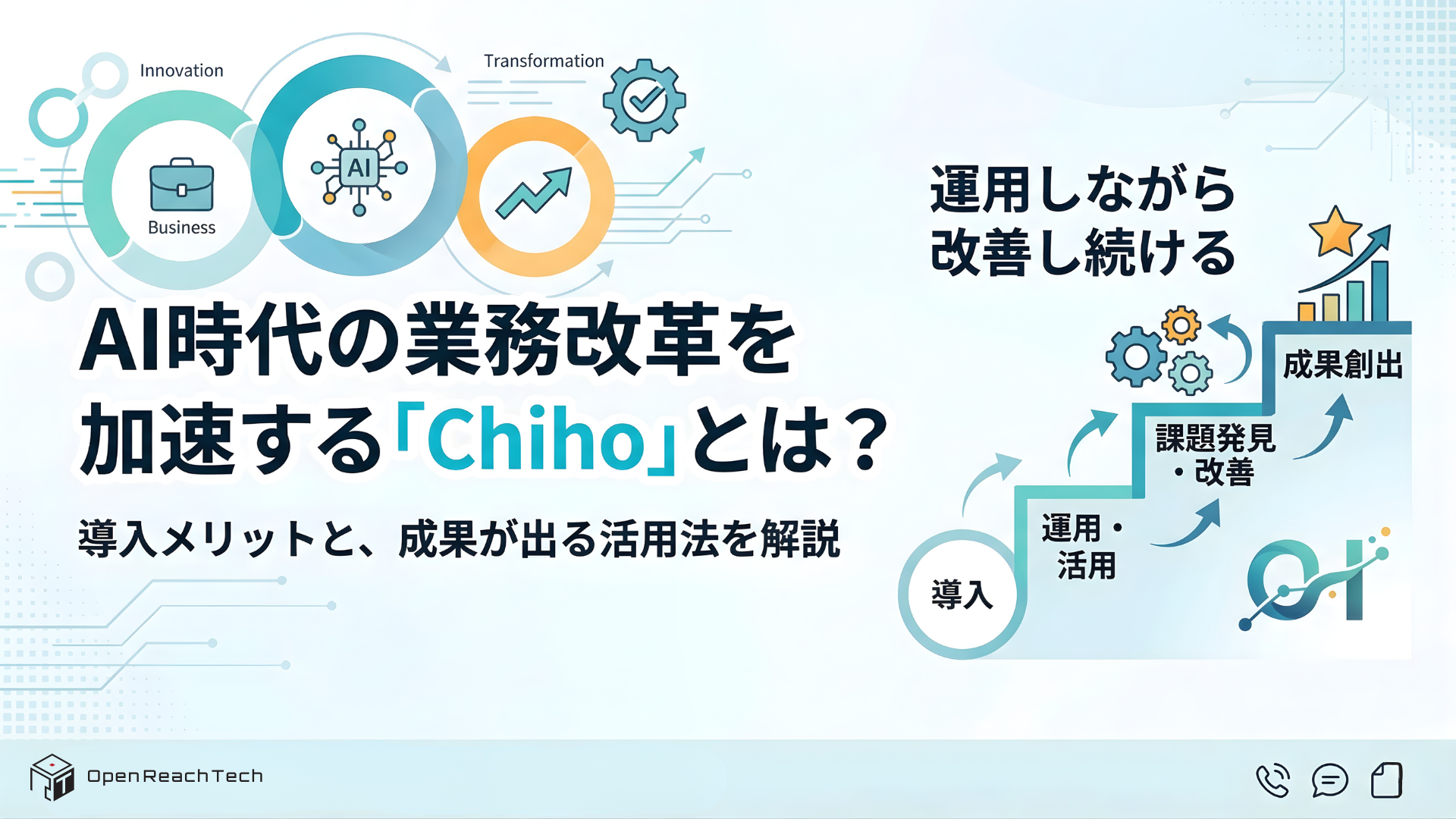
Chiho supports companies from introducing AI tools to establishing them as fully integrated business systems. This article explains Chiho’s features, benefits, pricing, and case studies — combining the advantages of SaaS and custom development.
Introduction
With the rapid advancement of AI (LLMs), improving and automating business operations has become far more practical than ever before. In fact, many companies are already replacing tasks such as meeting minutes creation, research, report generation, and customer support with AI.
However, many organizations still face challenges such as:
- ChatGPT and similar tools have been introduced, but usage remains limited to individuals
- Partial optimization is possible, but overall business processes remain unchanged
- Integration with existing systems is difficult, increasing operational complexity
- SaaS costs grow significantly as the number of users increases, making company-wide adoption difficult
These problems occur because there is a major gap between simply introducing AI tools and successfully embedding them into real business operations.
Chiho is an AI-powered business system specifically designed to bridge that gap.
In this article, we will explain why Chiho is effective for enterprise DX (Digital Transformation), what features it provides, and the benefits companies can gain from implementation.
1. Why Many Companies Struggle with AI-Driven DX
Most companies agree on one goal: increasing the amount of work that can be handled by AI.
However, in reality, businesses often encounter the following three major barriers.
1-1. The Barrier of Partial Optimization
Improvements such as generating text or summarizing information with prompts can be implemented quickly.
However, real business operations consist of multiple connected processes, including:
information gathering → decision-making → approval → recording → sharing.
Even if only one part is automated with AI, overall optimization cannot be achieved if surrounding processes remain manual.
As a result, companies often end up with a situation where AI is “convenient,” but business operations themselves do not fundamentally improve.
1-2. The Barrier of Integration and Operations
To make AI truly functional within a business, it must connect with existing data and systems.
This includes:
- Task management
- Documents
- Customer information
- Emails
- Internal rules
The more tools that need to be connected, the greater the operational burden becomes.
1-3. The Barrier of Cost and Scalability
SaaS solutions are easy to introduce, but most rely on per-user pricing models.
This is manageable at a small scale, but costs can increase dramatically during cross-department or company-wide deployment, creating significant investment hurdles.
In other words, truly successful AI adoption requires more than just introducing chat tools — it requires a system capable of handling entire business workflows.
2. What Is Chiho?
Chiho is an AI-powered business system that can be flexibly expanded according to each company’s requirements while providing core AI functionality such as:
- AI Chat
- AI Workflow
- AI Agents
- MCP / Tools Integration
Its biggest characteristic is its hybrid delivery model that combines:
prebuilt packages + custom development
Specifically:
- Launch quickly using proven core functionality
- Customize according to each company’s workflows and data structures
- Continuously improve after deployment through task-based development
This approach allows Chiho to combine the convenience of SaaS with the flexibility of custom-built systems.
3. Main Features of Chiho
Chiho integrates AI capabilities with business management functions to create a system that can be practically used in real operational environments.
3-1. AI Features
| Feature | Overview |
|---|---|
| AI Agent Management | Create and manage AI agents with specific business roles. Standardize prompts for consistent operations. |
| AI Chat | Communicate with AI agents while dynamically selecting the most suitable AI model depending on the situation. |
| AI Document Generation | Generate reports, meeting minutes, proposals, specifications, and centrally manage them within the system. |
| AI Workflow | Automate multi-step business processes and standardize workflows that are usually dependent on individuals. |
| MCP / Tools Integration | Connect with external systems and existing data sources so AI can perform real operational tasks. |
| Prompt Export | Reuse prompt assets developed inside the system in external AI environments. |
3-2. Business Management Functions (Optional Integration)
AI alone is not enough to complete business operations. Chiho can also integrate business management features such as:
- Document management
- Project management
- Issue management
- Task management
- Email distribution
This prevents operational information from becoming fragmented and enables AI to be naturally integrated into daily work processes.
4. Why Companies Choose Chiho
4-1. Comparison with Typical SaaS
| Comparison Item | Typical SaaS | Chiho |
|---|---|---|
| Pricing Structure | Primarily user-based pricing. Costs increase as usage grows. | Can be designed to minimize dependence on user count. |
| Customization | Limited to provided functionality. | Freely expandable according to business requirements, including niche operations. |
| System Integration | Mainly based on standard APIs. Custom requirements can be difficult. | Flexible implementation tailored to existing systems and workflows. |
4-2. Comparison with Full Scratch Development
| Comparison Item | Full Custom Development (Scratch) | Chiho |
|---|---|---|
| Development Time & Cost | Requires significant time and cost from requirements definition to full implementation. | Faster initial setup by utilizing core packages. |
| Stability | Higher risk of unknown bugs during initial release. | Built on a proven operational foundation. |
| Post-Launch Improvement | Additional development can become difficult to manage. | Continuous improvements are easier through task-based development. |
Chiho is a practical option that avoids the heaviness of building everything from scratch while still optimizing for each company’s unique operations.
5. The Difference Made by Task-Based Development
AI adoption does not end at implementation. Real business value comes from continuously improving operations after deployment.
Chiho provides post-launch support through task-based development.
Examples include:
- Prioritizing issues that arise during actual operations
- Making small improvements and continuously validating results
- Updating AI utilization methods as business operations evolve
This cycle prevents the system from becoming outdated and keeps it aligned with real operational needs.
6. Pricing Plans (Reference)
Initial Cost
- ¥2,000,000 (Chiho installation and implementation fee)
Monthly Maintenance Fee
| Monthly Fee | Plan Details |
|---|---|
| ¥50,000 | Error monitoring and bug fixes only |
| ¥150,000 | ¥50,000 plan + core package updates |
| ¥300,000 | ¥150,000 plan + approximately 60 hours of task-based development |
| ¥600,000 | ¥150,000 plan + task-based development (contact us for details) |
| ¥900,000 | ¥150,000 plan + task-based development (contact us for details) |
| Custom | Individually quoted according to requirements |
Pricing can be optimized based on the desired improvement speed and internal development capabilities.
7. Case Studies
Case Study 1: Software Development Company A
Background
- Wanted to use Generative AI safely across the team
- Needed to reduce SaaS costs caused by increasing user numbers
- Wanted to improve monthly reporting efficiency
Implementation
- Operated as a secure alternative to ChatGPT Team
- Enabled mobile AI usage outside the office
- Automated data aggregation and document generation with AI Workflow
- Reused AI agents for code generation and review processes
Results
- Standardized work quality
- Reduced dependency on individuals
- Reduced reporting workload
Case Study 2: Online Education Company
Background
- Wanted to strengthen personalized learning support
- Needed to reduce instructor workload for answering student questions
Implementation
- Built AI agents based on student learning history and understanding levels
- Provided 24/7 question answering and learning support
Results
- Improved student satisfaction
- Reduced instructor workload
- Established a continuous learning support system
8. Recommended for Companies That Want To:
- Turn AI adoption into real business outcomes rather than stopping at PoC
- Integrate AI with existing systems and operational workflows
- Pursue organization-wide optimization instead of partial optimization
- Reevaluate operational costs heavily dependent on SaaS
- Build an AI platform tailored to their own business operations
9. Contact Us for Consultation
Chiho is not simply about introducing AI tools — it is an initiative to improve your company’s business processes themselves.
Even if your organization is still at the stage of:
“We’re not sure where to start” or “We’re unsure whether AI can really work for our business”
we are happy to help.
We will review your current operations and propose high-priority use cases for implementation.
Helpful Information to Share During Consultation
- Business operations you want to digitize or automate with AI
- Systems currently in use
- Expected number of users
- Security and operational requirements
Examples of Consultation Topics
- Evaluating whether Chiho fits your business operations
- Migration consultation from existing SaaS or scratch systems
- Planning phased implementation according to budget
- Designing a concrete task-based development plan
The initial design phase greatly impacts the effectiveness of AI adoption. Contact us to discuss the best implementation strategy for your business.
10. Recommended Implementation Process (3 Steps to Reduce Failure Risk)
When implementing Chiho, it is more effective to gradually expand from areas where results can be achieved quickly rather than replacing all operations at once.
Step 1: Identify Priority Use Cases
First, identify operations that:
- Require significant manual effort
- Depend heavily on individuals
- Have inconsistent quality
Examples include:
- Periodic report generation
- Meeting minutes organization
- Initial customer inquiry responses
- Specification updates
These are areas where results are easier to visualize in a short period of time.
Step 2: Implement Small and Validate Through Operations
Implement AI agents, AI workflows, and necessary MCP/Tools integrations tailored to the target operations.
After deployment, evaluate:
- Output quality
- Processing time
- Workload reduction for employees
Then identify improvement opportunities based on actual operational data.
Step 3: Expand and Standardize
Once effectiveness is confirmed, expand into similar operations.
Successful prompts and workflows can be reused and standardized across the organization, enabling stable operations that rely less on individual experience.
Through these three steps, AI becomes not a one-time initiative, but an ongoing improvement activity that contributes directly to business performance.
11. Summary
Chiho is an AI-powered business system designed to solve practical business challenges that cannot be addressed simply by introducing AI chat tools.
Its key strengths include:
- Fast implementation using proven core functionality
- Flexible expansion tailored to unique business operations
- Continuous improvement through task-based development after deployment
These strengths enable companies to move beyond “DX experimentation” and achieve real operational results.
Even if your company is still uncertain about its AI strategy, the best first step is to organize and clarify current operational challenges. We will help design the most suitable implementation scenario for your business and accelerate time-to-value.
Reference Materials
- Feature List: https://chiho-docs.pages.dev/ja
- Working Hour Calculation Method: https://www.canva.com/design/DAGySo382LA/lemK1fWnFIOiCFiE4Z75EQ/edit