FAQ for Companies Considering System Development with Open Reach Tech

This FAQ document is provided for companies considering outsourcing system development to Open Reach Tech. It has been prepared in advance to help all clients proceed with confidence before starting a project with us.
Frequently Asked Questions (FAQ) About System Development
We have compiled a list of frequently asked questions regarding our system development services, contracts, and project workflows by category. Please use this as a reference when considering working with us.
1. Company Experience & Reliability
Q. What industries and business domains have you worked with in the past?
A. We are not limited to a specific industry. We have extensive experience developing web-related systems such as CRM platforms, e-commerce carts, blockchain systems, and LLM-powered applications.
Q. Can you share specific examples of systems you have developed?
A. Yes. Please refer to the following service materials for case studies and examples: https://drive.google.com/file/d/1jCLhJgRP09d4BqfVCDyGMiATUXO3reQv/view?usp=sharing
Q. Do you have experience developing e-commerce sites or web services?
A. Yes. We have experience developing e-commerce cart platforms used by external companies for registration, subscription billing, and operations.
Q. Are you stronger in B2B or B2C development?
A. We are particularly strong in B2B systems such as CRMs, but we also have experience developing B2C services.
Q. Do you have experience handling large-scale systems or high-traffic services?
A. Yes. Our current track record includes systems supporting approximately 1,000 concurrent users and around 30,000 DAU.
Q. What is the shortest development and release timeline you have achieved?
A. We developed and released a business matching application for a closed community of several hundred users within two months.
Q. What is the longest-running project you have maintained?
A. Most of our projects are maintained for over one year, and our longest-running project has been in operation for more than four years.
Q. What size companies are your clients?
A. Our clients range from small companies with around five employees to enterprises with several thousand employees. Most commonly, we work with companies ranging from several dozen to several hundred employees.
Q. Have you experienced major project failures or cancellations?
A. We have experienced delays in some projects, but we have not had any projects completely fail before release. Including smaller projects, we estimate having handled around 50 projects so far.
Q. What is your client retention rate?
A. Currently, we have had no cases where clients canceled within one year after system release. Some projects naturally ended after launch depending on business goals.
Q. What is your biggest strength compared to large SIers or low-cost development companies?
A. Our greatest strengths are high quality and cost efficiency. Compared to low-cost vendors, our pricing may be slightly higher, but compared to large SIers, we can often provide services at roughly 30–40% of the cost while maintaining high engineering quality through standardized development processes.
Q. Do you publicly share client reviews or case study interviews?
A. We are currently preparing them for publication.
Q. Have your systems contributed to increased revenue or cost reduction for clients?
A. Yes. Many systems we developed continue to be operated long-term after release.
Q. Since you utilize Vietnamese engineers, do you have extensive offshore development experience?
A. Yes. Our founders originally worked with offshore development partners but recognized issues in quality and communication. Open Reach Tech was founded specifically to solve those challenges.
Q. How long has your company been operating, and what is your current company size?
A. As of May 2026, we are in our sixth year since founding. We operate with a team of about 10 people at our Japan headquarters (5 full-time and 5 contract employees) and around 20 full-time employees at our Vietnam branch.
Q. Can you share examples of LLM-based systems and their impact?
A. Yes. Examples include:
- Case 1: Implemented AI-generated subtitles for internal training videos at a large enterprise.
- Case 2: Built an AI workflow platform within the Chiho system, significantly reducing internal training and documentation costs.
Q. How do you recruit and retain talented engineers in Vietnam?
A. We primarily recruit graduates from top Vietnamese universities such as Hanoi University of Science and Technology and Vietnam National University. We require English proficiency equivalent to IELTS 6.0 or higher and offer salaries above market standards in Hanoi. We also emphasize problem-solving ability during recruitment rather than simply testing technical execution skills.
Q. What was the most technically difficult external system integration you have handled?
A. One of the most challenging projects involved migrating all business data and logic from Salesforce into a newly developed CRM system. The extensive business logic required significant effort in requirement coordination.
2. Technology Stack, Development Methodology & Quality
Q. What programming languages and frameworks do you support?
A. To maintain quality, we generally standardize the languages and frameworks used. Most projects use Node.js and Express for the backend, and NuxtJS for the frontend. If you have specific preferences, we can discuss possible support.
Q. Why do you primarily use NuxtJS and Node.js?
A. Their rich ecosystems and performance are major advantages. However, we believe architecture quality is far more important than the choice of language or framework itself. In many cases, “how you use technology” matters more than “what technology you use.”
Q. Can you handle cloud infrastructure setup and architecture design?
A. Yes. We have experience ranging from on-premise server management to AWS and GCP cloud environments.
Q. Can you integrate existing on-premise systems with new cloud systems?
A. Yes. We have experience integrating with on-premise infrastructure.
Q. Can you develop smartphone applications?
A. Yes. While we currently have limited native mobile development experience, we can collaborate with partner companies if necessary.
Q. Can you develop AI or machine-learning systems?
A. Yes. LLM-related systems are one of our specialties.
Q. What do you mean by “fully utilizing modules”?
A. We have internally developed parts of our own web framework and built reusable modules that accelerate development across projects.
Q. How flexible is customization?
A. Completely flexible. Aside from our preferred language/framework choices, there are essentially no restrictions on functionality implementation.
Q. Can you handle legacy system replacements and migrations?
A. Yes. We have completed multiple large-scale migrations from SaaS platforms such as CRMs and e-commerce systems.
Q. Can you integrate with external APIs and third-party systems?
A. Yes. Since we primarily perform custom development, we can handle integrations flexibly.
Q. What testing practices do you follow?
A. As a rule, we write unit tests for all functions. For integration testing, engineers follow internal AI-assisted testing workflows.
Q. How do you ensure code quality?
A. We enforce strict coding standards and shared modules so that all engineers follow the same design philosophy and formatting standards.
Q. How is your task-based development different from Agile or Scrum?
A. The biggest difference is transparency. All tasks and issues are shared with the client in real time. In addition, billing is task-based rather than based on engineer-months, enabling more efficient resource allocation.
Q. How do you define task completion?
A. In principle, a task is considered complete once implementation is finished and reflected in the development environment. Chiho Client is continuously evolving to support more detailed states such as “Released” and “Under Review.”
Q. Can development start before requirements are fully finalized?
A. Yes. We can support and guide the requirement definition phase from the beginning. We recommend starting with the minimum plan to support initial requirement planning.
Q. Can you handle requirement changes during development?
A. Absolutely. One of the advantages of custom development is flexibility in adapting to change.
Q. Can you handle UI/UX design as well?
A. Yes. We have talented in-house designers.
Q. How is the “Multiple” productivity coefficient determined?
A. Multiple values are determined through internal evaluations. Roughly:
- Internship ~ Junior: 0.8 ~ 1.5
- Junior ~ Mid-level: 1.5 ~ 2
- Senior and above: 2+
- PM: 2+
If requested, we can also disclose the assigned engineer’s Multiple value.
Q. How do you evaluate engineer skill levels?
A. We improve review and knowledge-sharing speed through standardized development flows and shared technology stacks. Reusable internal modules also greatly reduce repetitive implementation work.
Q. Can you design scalable systems?
A. Yes. We have experience operating infrastructure for major international blockchain projects.
Q. How do you handle performance optimization?
A. As systems grow, we optimize queries, scale server resources, and implement load balancing as needed.
Q. Can you develop SEO-friendly websites?
A. Yes for implementation. However, we generally recommend clients handle SEO strategy while we focus on technical implementation.
Q. Do you provide staging environments?
A. Yes, although server costs are generally billed separately.
3. Pricing, Contracts & Plans
Q. What are the differences between the 300,000 JPY, 600,000 JPY, and 900,000 JPY monthly plans?
A. The main difference is allocated development hours.
- 300,000 JPY: Small-scale projects, PoCs, websites
- 600,000 JPY: Small-to-mid scale systems
- 900,000 JPY+: Larger systems or technically advanced projects
Q. How much work is included in the minimum plan?
A. The 150,000 JPY/month plan includes approximately 30 hours of work per month.
Q. How should we choose the right plan?
A. We can estimate based on project size and complexity. Consultations are free.
Q. Can plans be upgraded or downgraded mid-project?
A. Yes. If additional work beyond allocated hours is required, we notify clients beforehand and bill additional tasks separately.
Q. What happens if the monthly budget limit is reached?
A. Development generally pauses until the following month unless additional work is approved.
Q. Is there a minimum contract period?
A. Contracts can be adjusted or canceled with one month’s notice.
Q. Are there any upfront fees?
A. No upfront fees. Additional charges only apply if work exceeds guaranteed hours.
Q. How is “productive time” calculated?
A. Productive Time = Actual Working Time × Multiple.
Q. What are your payment terms?
A. Typically, invoices are closed at month-end and paid by the end of the following month.
Q. Are cancellations allowed?
A. Yes. There are no cancellation penalties, but one month’s notice is required.
Q. Are your contracts based on quasi-mandate or fixed-price agreements?
A. Task-based development generally uses quasi-mandate contracts, though fixed-price contracts are also possible depending on project scale.
Q. Who owns the developed system?
A. Ownership belongs to the client.
4. Project Management & Transparency
Q. What is Chiho Client?
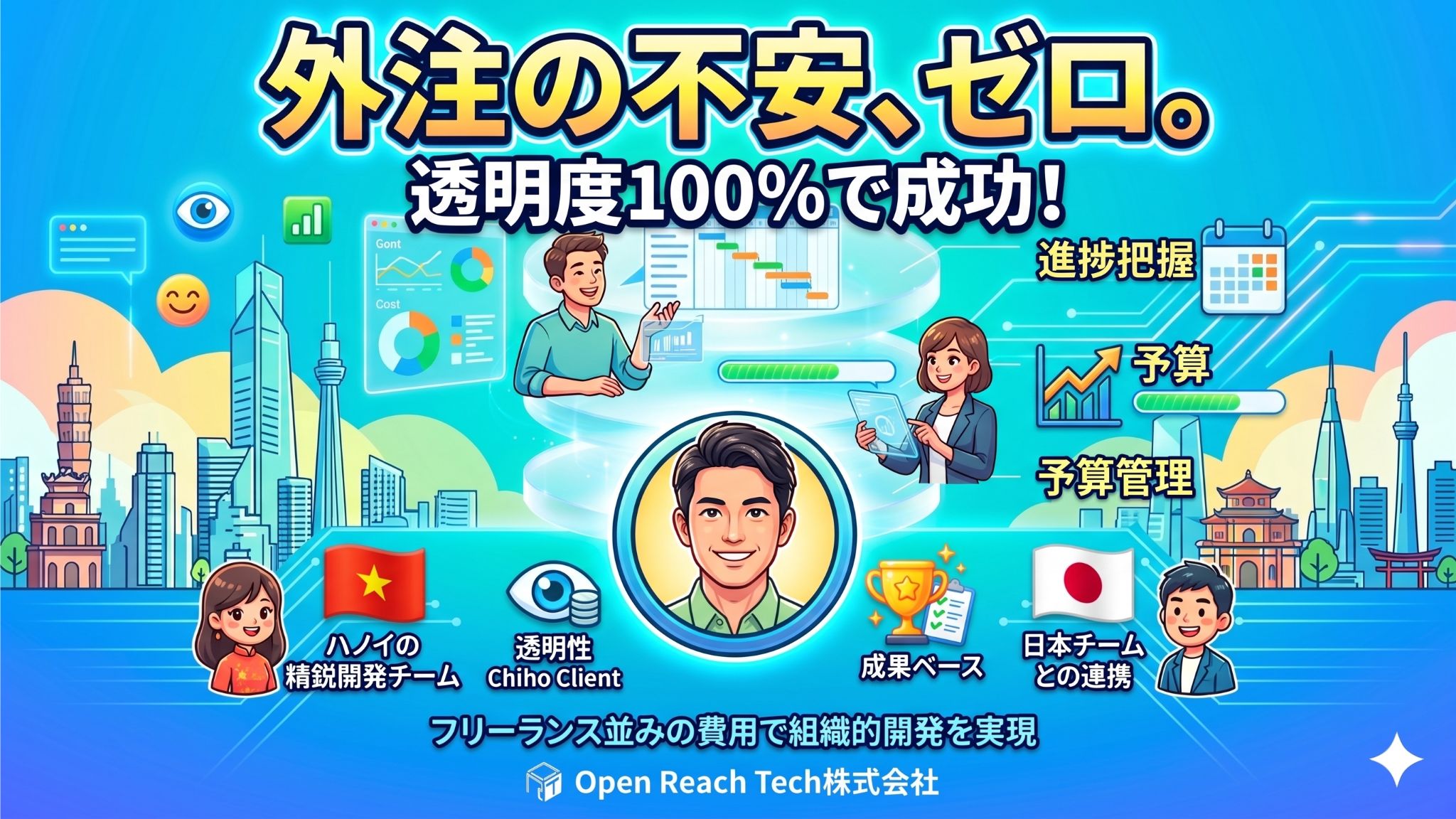
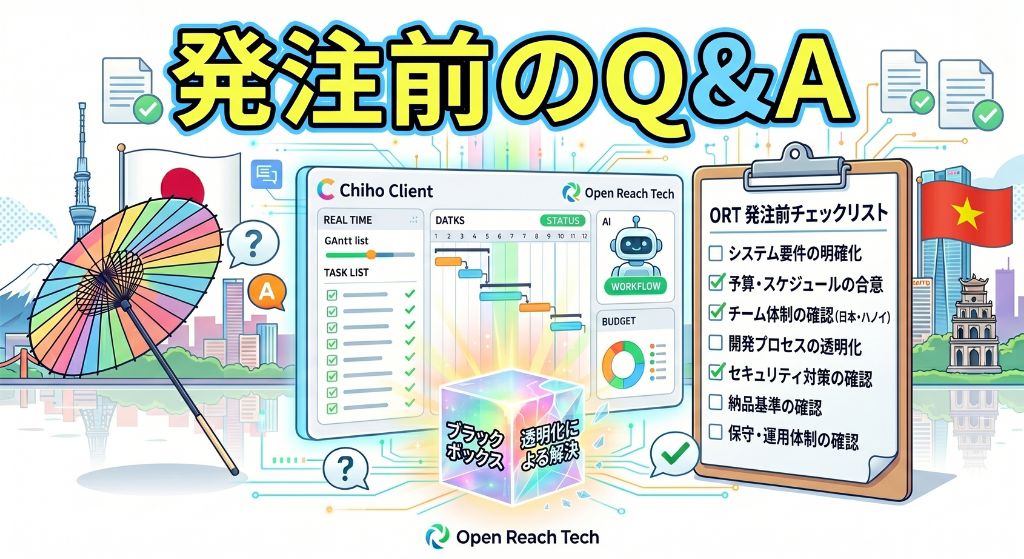
A. Chiho Client is a system that allows clients to monitor project tasks, issues, and related files in real time. Clients can access nearly the same information available internally to our team.
Q. Can Chiho Client be used on smartphones and tablets?
A. Yes. It is fully responsive.
Q. Are there additional licensing fees for Chiho Client?
A. No. Since it is our own system, there are no additional usage fees.
Q. Can multiple client accounts be issued?
A. Yes, free of charge.
Q. Can non-technical stakeholders understand the system?
A. Yes. Most users become comfortable within one or two weeks.
Q. How often are tasks updated?
A. Usually almost daily, with weekly task organization every Monday or Tuesday.
Q. What is included in monthly reports?
A. Completed tasks, productive hours, release details, and related project information.
Q. How are regular meetings conducted?
A. Meetings are generally online and last around 30 minutes.
Q. How do you prevent communication misunderstandings?
A. All system-related requests are tracked as explicit issues within Chiho Client.
5. Team Structure & Resources
Q. What team structure do you assign to projects?
A. Team size depends on the project requirements and selected technology stack.
Q. What are the roles of Japanese PMs and Vietnamese engineers?
A. Japanese staff primarily handle communication and requirements, while Vietnamese engineers focus on implementation. However, responsibilities are often collaborative.
Q. Is there a language barrier?
A. Some barriers exist, but AI tools and Chiho Client help reduce them significantly.
Q. Are PMs dedicated exclusively to one project?
A. Generally no, although dedicated PM assignments may be discussed depending on budget.
Q. Can team members change during development?
A. It is possible, though uncommon. We minimize handover costs through documentation and standardized systems.
Q. Can our in-house engineers collaborate with your team?
A. Yes, though alignment with our development stack and processes is preferred.
Q. Do you have dedicated QA staff?
A. No. Engineers are responsible for testing their own implementations.
Q. Can the team scale up or down monthly?
A. Yes. Plans can be adjusted monthly.
Q. Can clients request specific engineers?
A. Generally no, though custom arrangements may be possible for higher-tier plans.
Q. Are your development speeds faster than typical outsourcing vendors?
A. We believe both our speed and quality are significantly above average.
6. Security, Maintenance & Operations
Q. Who owns copyrights and intellectual property?
A. In principle, ownership belongs to the client. However, reusable internal modules may remain reusable by our company across projects.
Q. Will source code be provided?
A. Yes. Source code can be shared even during development.
Q. Can we sign an NDA before discussions?
A. Yes.
Q. How do you handle security?
A. We maintain internal security checklists for all systems and add project-specific security measures when necessary.
Q. Can you provide maintenance after release?
A. Yes. Maintenance plans start from 150,000 JPY/month.
Q. Can systems eventually be internalized by our company?
A. Yes. We do not hide information. However, system handovers typically require significant effort and preparation.
Q. Can you create manuals or operation videos?
A. Yes. These can be handled as part of task-based development.
Q. Can another vendor take over maintenance in the future?
A. Yes. Specifications and source code can be fully shared upon request.
Reference
You can learn more about our task-based development approach in the document below: